 ThermSpec
An auditor once asked a heat treat quality manager for the current temperature uniformity survey on a production vacuum furnace. The furnace had run parts all week. The chart was in a shared drive folder nobody had opened since the last Nadcap prep cycle. That gap — not a bad thermocouple, not a failed soak — is how pyrometry compliance breaks down in real shops.
AMS 2750H pyrometry compliance is the aerospace industry’s framework for making sure furnace temperatures are measured correctly, controlled consistently, and documented in a way that holds up under audit. If your facility heat treats parts to aerospace specs, you have probably seen AMS 2750 invoked on a purchase order, a Nadcap checklist, or a customer flow-down. The revision letter matters: AMS 2750H is the current revision facilities are expected to follow unless a contract explicitly references an older one.
Note: ThermSpec is not affiliated with SAE International. AMS 2750 is a trademark and specification of SAE. This article is educational guidance for heat treat professionals, not an official interpretation of the standard.
What pyrometry means in a heat treat shop
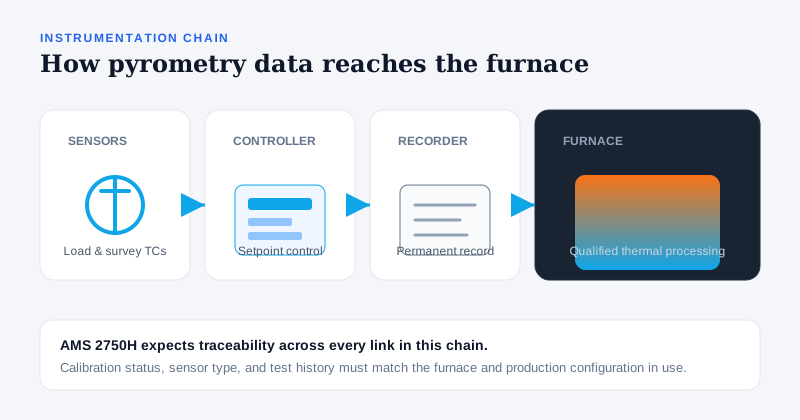
Pyrometry is the measurement and control of high temperatures in thermal processing equipment. On a shop floor, that is not an abstract lab exercise. It is the thermocouple in the load, the controller reading it, the chart recorder or digital historian capturing the cycle, and the quality records that prove the furnace was qualified before production started.
When people say a furnace is “in pyrometry compliance,” they mean the full chain — sensors, instruments, surveys, tests, and records — matches what AMS 2750H requires for that furnace class and application. A furnace can heat parts beautifully and still fail an audit if the wrong sensor type is installed, a TUS is overdue, or the SAT record does not match the controller in use.
What AMS 2750H actually requires
At a high level, the specification organizes requirements around a few durable pillars. The details live in the document itself and in your customer’s process specs, but most shops encounter the same core obligations:
- Qualified instrumentation — Controllers, recorders, load thermocouples, survey sensors, and field test instruments must meet allowed types, calibration intervals, and replacement rules.
- Furnace classification and work zones — Each furnace operates within a defined class and qualified workload zone established by testing, not by assumption.
- Temperature Uniformity Surveys (TUS) — Periodic tests that prove temperature variation across the work zone stays within class limits.
- System Accuracy Tests (SAT) — Tests that compare the control and recording system against a known standard to verify accuracy.
- Records and traceability — Documentation that connects a production cycle to an approved furnace configuration at the time parts were processed.
Revision H continues the industry’s push toward clearer instrument management, updated sensor requirements, and tighter alignment with how modern furnaces are equipped. If your procedures still cite language from an earlier revision, that is one of the first places an auditor will look.
Who must comply — and when it shows up on your desk
AMS 2750H applies when the contract, material specification, or accreditation program requires it. The most visible trigger is aerospace heat treat work governed by Nadcap HT (heat treating) audits. Prime contractors and Tier suppliers flow pyrometry requirements down to subcontractors who may run a single furnace or a dozen lines across two sites.
You do not need to be a household-name OEM to feel the weight of the spec. A 10-person brazing shop running one atmosphere furnace for a single aerospace customer is subject to the same pyrometry logic as a multi-site commercial heat treater — scaled to furnace count, not company size.
TUS and SAT: the two tests shops confuse most often
If pyrometry compliance had a greatest-hits list, TUS and SAT would top it. They are related, but they are not interchangeable.
A temperature uniformity survey answers: Is temperature consistent enough across the qualified work zone for this furnace class? Survey thermocouples are placed according to the spec and your furnace geometry. Results determine or confirm the furnace class and the volume where you may load production parts.
A system accuracy test answers: Is the control and recording system reading temperature correctly compared to a known standard? The SAT compares instrumentation in the control loop — not the same question as uniformity across a load volume.
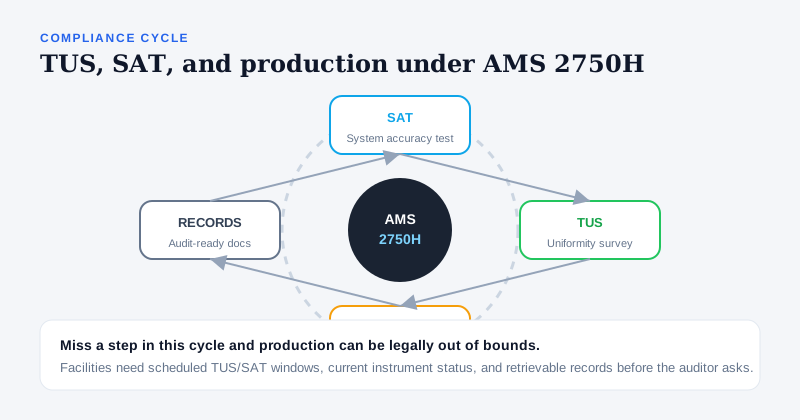
Miss a scheduled TUS window, run production on a failed survey, or let an SAT expire without a documented retest, and you are no longer making a technical argument — you are making a compliance argument. Those rarely end in your favor.
Furnace classes, thermocouples, and the details that catch shops
Furnace class drives survey frequency, allowable variation, and how much margin you have in daily production. Shops get into trouble when the class on paper does not match how the furnace is actually loaded, or when a process change outruns the pyrometry paperwork.
Thermocouple management is the other daily friction point. Base metal versus noble metal types, allowed uses, extension wire, replacement intervals, and limits of error are not administrative trivia. Using the wrong sensor in the wrong application — or exceeding allowed life — is a common audit finding because the evidence shows up directly on charts and in instrument logs.
Fixed shop instrumentation adds another layer: controllers, recorders, and field standards each carry calibration and identification requirements. A facility running multiple furnaces with mixed instrument vendors can stay compliant, but only if each configuration is registered, tested, and traceable on its own merits.
Where compliance usually breaks down
Most failures are not mysterious metallurgy problems. They are operational:
- TUS or SAT dates tracked in spreadsheets that nobody updates until audit prep
- Survey results stored in one system, production charts in another, instrument lists in a binder
- Replacement thermocouples installed without updating the furnace’s approved configuration
- Technicians running tests on the floor while quality chases signatures after the fact
- Multi-site operations where each plant interprets the spec slightly differently
The pattern is consistent: the furnace runs, parts look fine, and the pyrometry system of record is fragmented. AMS 2750H does not care that the shop is busy. It cares that you can prove the furnace was qualified when the load went in.
How modern shops stay ahead of audits
Strong programs treat pyrometry as a living system, not a folder of PDFs refreshed once a year. That usually means a single source of truth for furnace registration, instrument lifecycle, TUS and SAT scheduling, and retrievable records — with guardrails that stop out-of-spec configurations before production starts.
Software does not replace the spec or the quality engineer’s judgment. It reduces the chance that a overdue survey, expired sensor, or mismatched controller slips through because three people maintain three different lists. For facilities moving off manual tracking, pyrometry platforms with built-in AMS 2750 validation — like ThermSpec — are designed to keep furnace data, test history, and audit evidence in one place.
See how ThermSpec tracks AMS 2750H pyrometry compliance
Register furnaces, schedule TUS and SAT windows, manage thermocouple life, and pull audit records from one system — with AMS 2750 guardrails built in.
Frequently asked questions
What is AMS 2750H pyrometry compliance?
It means your heat treat facility measures, controls, and documents furnace temperatures according to SAE AMS 2750 Revision H — including qualified instrumentation, current TUS and SAT results, thermocouple management, and retrievable records.
Who must comply with AMS 2750H?
Facilities performing aerospace heat treat work where the spec is invoked by a customer, material specification, or Nadcap accreditation. Subcontractors with a single furnace are in scope when pyrometry requirements flow down to them.
What is the difference between a TUS and an SAT?
A TUS verifies temperature uniformity across the qualified work zone. An SAT verifies that the control and recording system measures temperature accurately against a known standard. Both are required, but they test different things.
How do auditors evaluate pyrometry compliance?
They review current TUS and SAT records, instrument calibration and replacement history, thermocouple traceability, furnace class documentation, and whether production records match the approved configuration in effect at the time of processing.